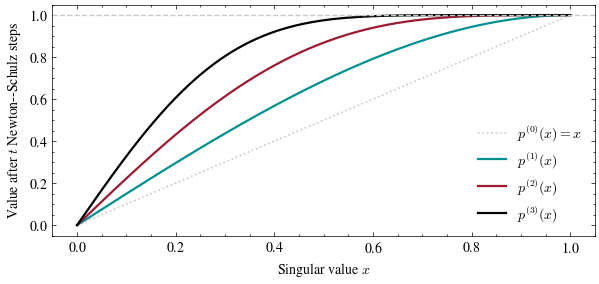
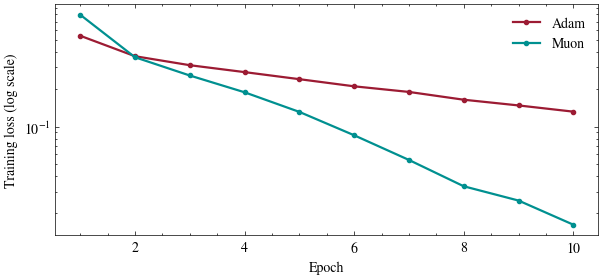
Muon orthogonalizes a gradient matrix \(\mathbf{G}\) with matrix multiplications that drive every singular value to \(1\) while preserving the singular vectors. First we watch the Newton–Schulz cubic \(p(x) = (3x - x^3)/2\) turn into a step function one iteration at a time. Then we train a real network two ways, with Adam and with Muon, and compare.
import numpy as npimport matplotlib.pyplot as pltimport scienceplotsimport torchimport torch.nn as nnfrom sklearn.datasets import fetch_openmlplt.style.use(["science", "no-latex"])TEAL, CARDINAL, GRAY ="#009090", "#9c1b33", "#c9c9c9"def p(x):return (3* x - x **3) /2x = np.linspace(0, 1, 400)fig, ax = plt.subplots(figsize=(7, 3))ax.plot(x, x, color=GRAY, linewidth=1.2, linestyle=":", label="$p^{(0)}(x) = x$")iterate = x.copy()for i, color inzip(range(1, 4), [TEAL, CARDINAL, "black"]): iterate = p(iterate) ax.plot(x, iterate, color=color, linewidth=1.6, label=f"$p^{{({i})}}(x)$")ax.axhline(1.0, color=GRAY, linewidth=1.0, linestyle="--")ax.set_xlabel("Singular value $x$")ax.set_ylabel("Value after $t$ Newton--Schulz steps")ax.legend(frameon=False, loc="lower right")plt.show()
Three iterations already lift everything above \(x \approx 0.5\) to within a few percent of \(1\), which is sign(x) for \(x > 0\).
Applying this cubic to a matrix, as \(\tfrac32\mathbf{X} - \tfrac12\mathbf{X}\mathbf{X}^\top\mathbf{X}\), applies \(p\) to each singular value separately. We check the claim on the matrix from the reading’s spectrum figure.
rng = np.random.default_rng(18)G = rng.standard_normal((12, 12))Gt = G / np.linalg.norm(G, 2) # rescale so the largest singular value is exactly 1before = np.linalg.svd(Gt, compute_uv=False)for _ inrange(5): Gt =1.5* Gt -0.5* Gt @ Gt.T @ Gt # one Newton-Schulz step: two matrix multiplicationsafter = np.linalg.svd(Gt, compute_uv=False)print("rescaled singular values of G:", np.round(before, 3))print("after 5 Newton-Schulz steps: ", np.round(after, 3))print(f"smallest: {before[-1]:.3f} before, {after[-1]:.3f} after")
Every singular value increased, the largest ones reached \(1\), and the smallest remains at \(0.196\): five steps is not enough for a badly conditioned matrix. This is the interval \([\ell, 1]\) from the reading. (Here we divided by the largest singular value, so the interval reaches \(1\); the training loop below divides by the Frobenius norm instead, which costs one pass over the entries and still keeps every singular value at most \(1\).) Problem 18 derives the number of steps needed for convergence.
Muon vs. Adam on real data
Train the same small MLP on MNIST with Adam and with Muon (momentum, orthogonalized by Newton–Schulz before every step).
torch.manual_seed(18)rng = np.random.default_rng(18)X, y = fetch_openml("mnist_784", version=1, return_X_y=True, as_frame=False, parser="auto")y = y.astype(int)idx = rng.choice(len(X), size=6000, replace=False)X, y = X[idx] /255.0, y[idx]n_train =5000Xtr_t = torch.tensor(X[:n_train], dtype=torch.float32)ytr_t = torch.tensor(y[:n_train], dtype=torch.long)Xte_t = torch.tensor(X[n_train:], dtype=torch.float32)yte_t = torch.tensor(y[n_train:], dtype=torch.long)class MLP(nn.Module):def__init__(self):super().__init__()self.fc1 = nn.Linear(784, 256)self.fc2 = nn.Linear(256, 10)def forward(self, x):returnself.fc2(torch.relu(self.fc1(x)))def newton_schulz(M, steps=5): Z = M / (M.norm() +1e-7) # Frobenius norm, so every singular value is at most 1for _ inrange(steps): Z =1.5* Z -0.5* Z @ Z.T @ Zreturn Z
def train(use_muon, epochs=10, lr=1e-3, muon_lr=0.02, beta=0.9): model = MLP() lossfn = nn.CrossEntropyLoss()ifnot use_muon: opt = torch.optim.Adam(model.parameters(), lr=lr) momentum = {prm: torch.zeros_like(prm) for prm in model.parameters()} losses = []for epoch inrange(epochs): perm = torch.randperm(len(Xtr_t))for i inrange(0, len(Xtr_t), 128): b = perm[i:i +128]for prm in model.parameters(): prm.grad =None loss = lossfn(model(Xtr_t[b]), ytr_t[b]) loss.backward()if use_muon:with torch.no_grad():for prm in model.parameters(): momentum[prm] = beta * momentum[prm] + prm.gradif prm.dim() ==2: # a weight matrix: orthogonalize prm -= muon_lr * newton_schulz(momentum[prm])else: # a bias vector: plain momentum prm -= lr * momentum[prm]else: opt.step()with torch.no_grad(): losses.append(lossfn(model(Xtr_t), ytr_t).item())with torch.no_grad(): acc = (model(Xte_t).argmax(1) == yte_t).float().mean().item()return losses, acclosses_adam, acc_adam = train(use_muon=False)losses_muon, acc_muon = train(use_muon=True)print(f"Adam: final training loss {losses_adam[-1]:.3f}, test accuracy {acc_adam:.1%}")print(f"Muon: final training loss {losses_muon[-1]:.3f}, test accuracy {acc_muon:.1%}")
Adam: final training loss 0.132, test accuracy 94.4%
Muon: final training loss 0.016, test accuracy 95.1%
Five Newton–Schulz steps approximate the polar factor closely enough for the training run above. Try ns_steps = 1 below and compare its result with Adam and the five-step run.
ns_steps =1# change me!def train_muon_custom(ns_steps, epochs=10, lr=1e-3, muon_lr=0.02, beta=0.9): model = MLP() lossfn = nn.CrossEntropyLoss() momentum = {prm: torch.zeros_like(prm) for prm in model.parameters()} losses = []for epoch inrange(epochs): perm = torch.randperm(len(Xtr_t))for i inrange(0, len(Xtr_t), 128): b = perm[i:i +128]for prm in model.parameters(): prm.grad =None loss = lossfn(model(Xtr_t[b]), ytr_t[b]) loss.backward()with torch.no_grad():for prm in model.parameters(): momentum[prm] = beta * momentum[prm] + prm.gradif prm.dim() ==2: prm -= muon_lr * newton_schulz(momentum[prm], ns_steps)else: prm -= lr * momentum[prm]with torch.no_grad(): losses.append(lossfn(model(Xtr_t), ytr_t).item())return losseslosses_custom = train_muon_custom(ns_steps)print(f"final training loss, Muon with {ns_steps} Newton-Schulz step(s): {losses_custom[-1]:.4f}")print(f"final training loss, Muon with 5 Newton-Schulz steps: {losses_muon[-1]:.4f}")print(f"final training loss, Adam: {losses_adam[-1]:.4f}")
final training loss, Muon with 1 Newton-Schulz step(s): 0.2049
final training loss, Muon with 5 Newton-Schulz steps: 0.0162
final training loss, Adam: 0.1319
With one Newton–Schulz step the momentum is barely orthogonalized and Muon loses to Adam; with five its training loss is eight times lower. The network, data, and loss are fixed, so the difference comes from the update direction.